How to Teach Financial Literacy in the Grocery Store
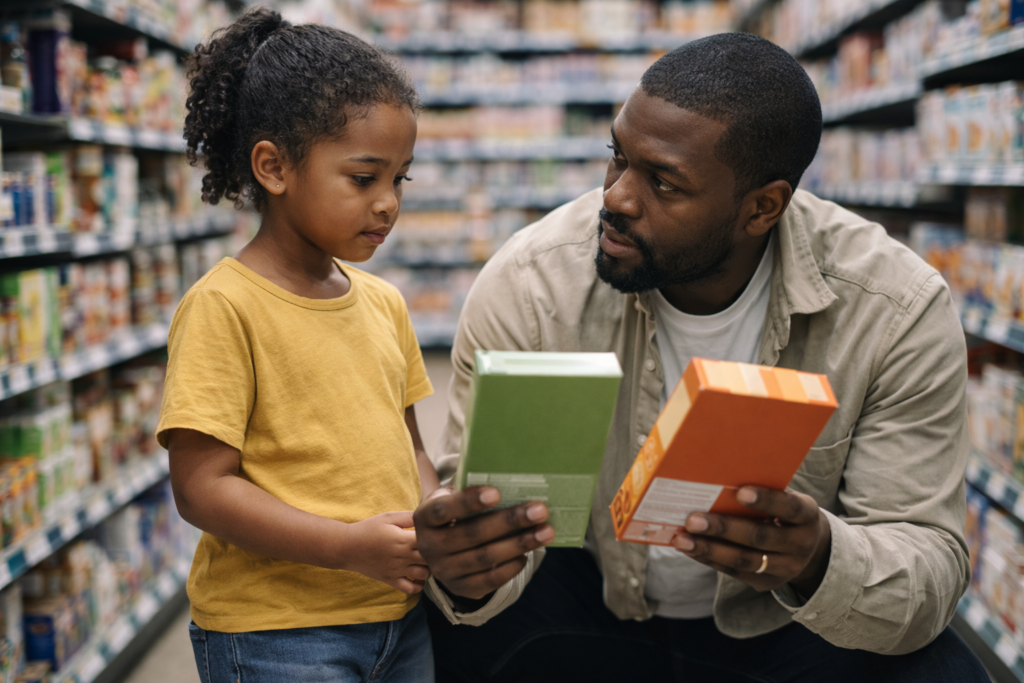
Most parents don’t think of the grocery store as a classroom. And if you’re anything like me, you want to get in and out as quickly as possible without breaking the bank.
But if you slow it down just a bit, it’s one of the most practical places to teach your child about money.
Every aisle is filled with real-world financial decisions. Bulk packaging versus standard. Brand name versus store brand. Chips and cookies versus fruits and vegetables. You don’t need to invent scenarios or create artificial lessons. The decisions are already right in front of you.
Replace “Yes or No” With a Question
Here’s where most parents miss the opportunity. When a child asks for something, we default to yes or no. That shuts down the conversation before it starts.
But if you replace that autopilot response with a question, you turn their brain on:
- “Which one do you think lasts longer?”
- “Why is this one cheaper?”
- “If we buy this, what are we not buying?”
Here’s what this looks like in real life: Your kid grabs a box of Fruit Loops. Instead of saying “Put it back,” you ask: “Why do you think this one cost $6 and Fruity Tootie’s costs $3? “They might say “It tastes better” or “The box looks cooler.” That’s fine. Now ask: “Is it $3 better? Or could we buy the cheaper one and use the extra money for something else?”
Don’t turn every trip into a pop quiz. Pick one or two moments per visit. If you drill them on every item, they’ll tune out and so will you.
Why This Setting Works
The beauty of this approach is that it turns a theoretical concept into reality. Budgets are visible. Choices come with opportunity costs. When a child sees that buying one item affects what’s left in the cart, they begin to understand that money is finite and decisions matter.
Children learn more when they participate in the decision-making instead of just watching it happen. When they explain their reasoning, even if it’s imperfect—they begin building the mental muscles required to make smart financial decisions.
Small Moments Add Up
You don’t need to turn every grocery run into a lesson, but when you do this consistently over time these moments accumulate. A child who has repeatedly compared prices at the grocery store is less likely to overspend impulsively as an adult. A child who has seen trade-offs early in life is less shocked by budget limits later.
Money lessons don’t have to be formal to be effective. They need to be consistent.
Turn These Moments into a System
Try this next trip: Pick one item your child asks for and turn it into a two-question conversation and see what happens. If you want to take these everyday moments and turn them into structured, repeatable conversations, Family Finance Night was designed to help you do exactly that. It builds on simple experiences like grocery shopping and organizes them into a system that grows with your child.
Download it for free using the form below.