How to Explain Inflation to Kids in 15 Minutes
What to say when your kid asks why everything costs more
Your kid has probably heard the word inflation by now. It’s on the news and it’s in the car when you’re crying about the cost of gas at the pump. At some point they’ll ask why things cost more.
You don’t need an economics lesson to answer their question. You need a banana. Let me explain.
The Idea
Most kids don’t understand why things cost what they do. They see the price of an item and think that’s just what it is. The banana costs 29 cents because that’s what bananas cost. Shoes cost $60 because that’s what shoes cost. The number simply exists without reason.
However, every item you own or consume took a trip to get there. Somebody grew it or built it, somebody moved it, somebody stored it, and somebody else moved it again. Every one of those steps cost money, and all of it is sitting inside the number on the price tag.
That’s the idea we want them to understand: the items we purchase are connected, and everything we own traveled to get here. If you begin the conversation with inflation and supply chains they’ll tune you out. Most adults will too. Save that for Economics 101.
The Activity: Trace the Banana
This takes about fifteen minutes and can be done at the kitchen table. Recommended age group is 5–12.
Step 1: Pick an Item in Your House
I suggest starting with a banana because it covers all bases. Someone must grow it, package it, transport it, and store it. There’s also a sticker on it telling you where it came from, so you can tell a story about the journey it took to get to your home.
You’ve got your banana. Now let’s find out where it’s been.
Step 2: Ask Where It’s From
The next step is to identify where the item came from. Ask your child, “Where do you think this came from?” If it’s a banana or food item, you can check the sticker or label. If it’s a toy or clothing, you may have to look it up online if you don’t have the original packaging.
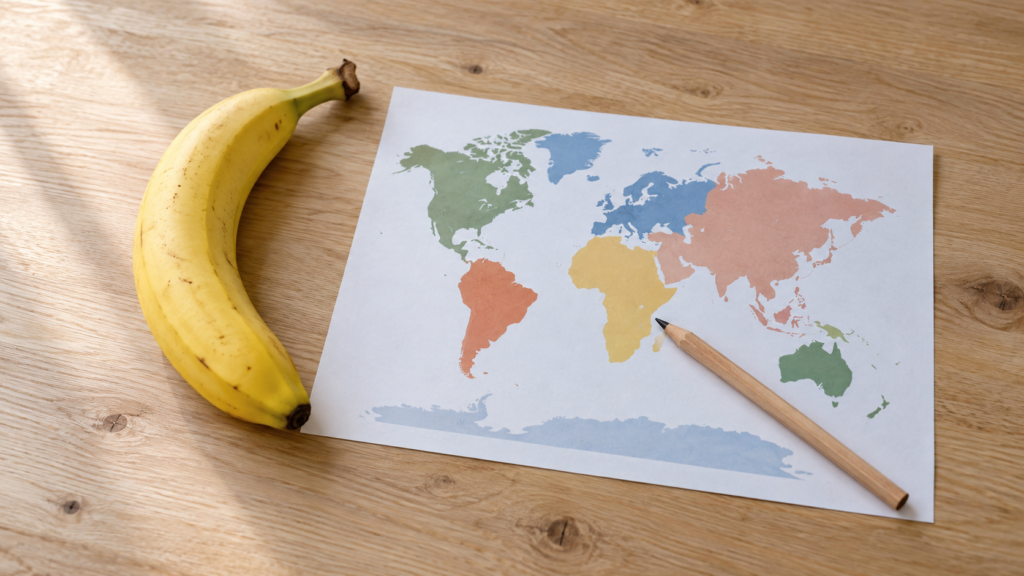
Once you figure out where it’s from, pull up a map and show them. That will help the lesson stick.
They now know where it started. Next up is the part most kids have never thought about: how it got from there to here.
Step 3: Trace the Trip
Before starting, ask them how many steps they think it will take for the item to get to their local store. Then walk it backward with them, step by step. For a banana, for example:
- Grown on a farm
- Picked by a person
- Trucked to a port
- Loaded onto a ship
- Sailed for a week or more
- Unloaded at a port where we live
- Trucked to a warehouse
- Trucked again to your grocery store
- Put on the shelf by someone who works there
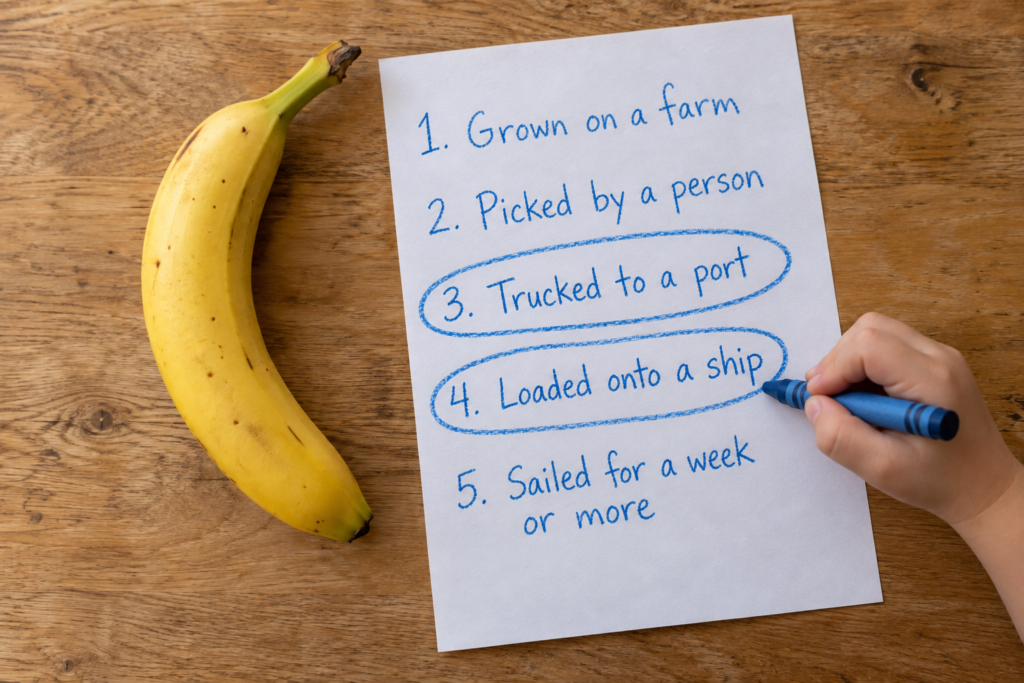
Nine steps. Was their initial guess correct?
Now let’s look at what each of those nine steps costs.
Step 4: Circle What Costs Money
Now go back through the list and have them mark every step where somebody had to be paid or fuel had to be provided.
It’s all of them! That’s the point, and it’s better if they discover it themselves than if you tell them.
The truck needed diesel. The ship needed fuel. The farmer got paid. The person who unloaded the boat got paid. The store pays for the building and the lights and the workers.
With this newfound understanding ask them, “So how much of that 29 cents do you think is the actual banana?”
Nobody really knows the answer, including you. And that’s fine. The point is the price tag didn’t just appear out of thin air.
Now that they can see what’s holding that price up, let’s knock a piece out of it.
Step 5: Break the Chain
Ask what happens if you remove one step:
- What if the ship breaks down?
- What if there’s a storm on the farm?
- What if everyone suddenly wants twice as many bananas?
Let them work through it. They’ll usually come up with the answer without help: the bananas show up late, or there are fewer of them, or they cost more.
Then the one that ties it together:
“So if it costs more to move things around, what do you think happens to the price on the shelf?”
Once they’ve done a banana, let them pick the next item. A toy, a pair of shoes, a box of cereal. It works better when it’s something they care about, and the second round is usually when it clicks.
Why This Sticks
Our four jars lesson teaches kids what to do with money they have. This teaches them that prices have a lot of inputs, they push against each other, and no single one controls the outcome. They can hold that idea. They already know a soccer game isn’t decided by one player.
Once they’ve traced one item, you’ll be surprised when they start doing it on their own. You’ll be in a store and hear “wait, how did this get here?” That’s the lesson in action, and it will make you smile as a parent.
Now the next time they overhear your doomsday political podcast, they can connect hearing “rising prices” to an actual process.
Make It a Family Finance Night
This activity works on its own, and it works even better as part of a routine. If you enjoyed this one, Family Finance Night gives you nine more.